
A useful report paragraph names the measure, gives the checked result and states the scope that makes the result interpretable. Keep a reference to the workbook and source records behind the number.
Start with the metric definition rather than copying a chart title into prose. The reader needs to know what was counted and what the denominator includes.
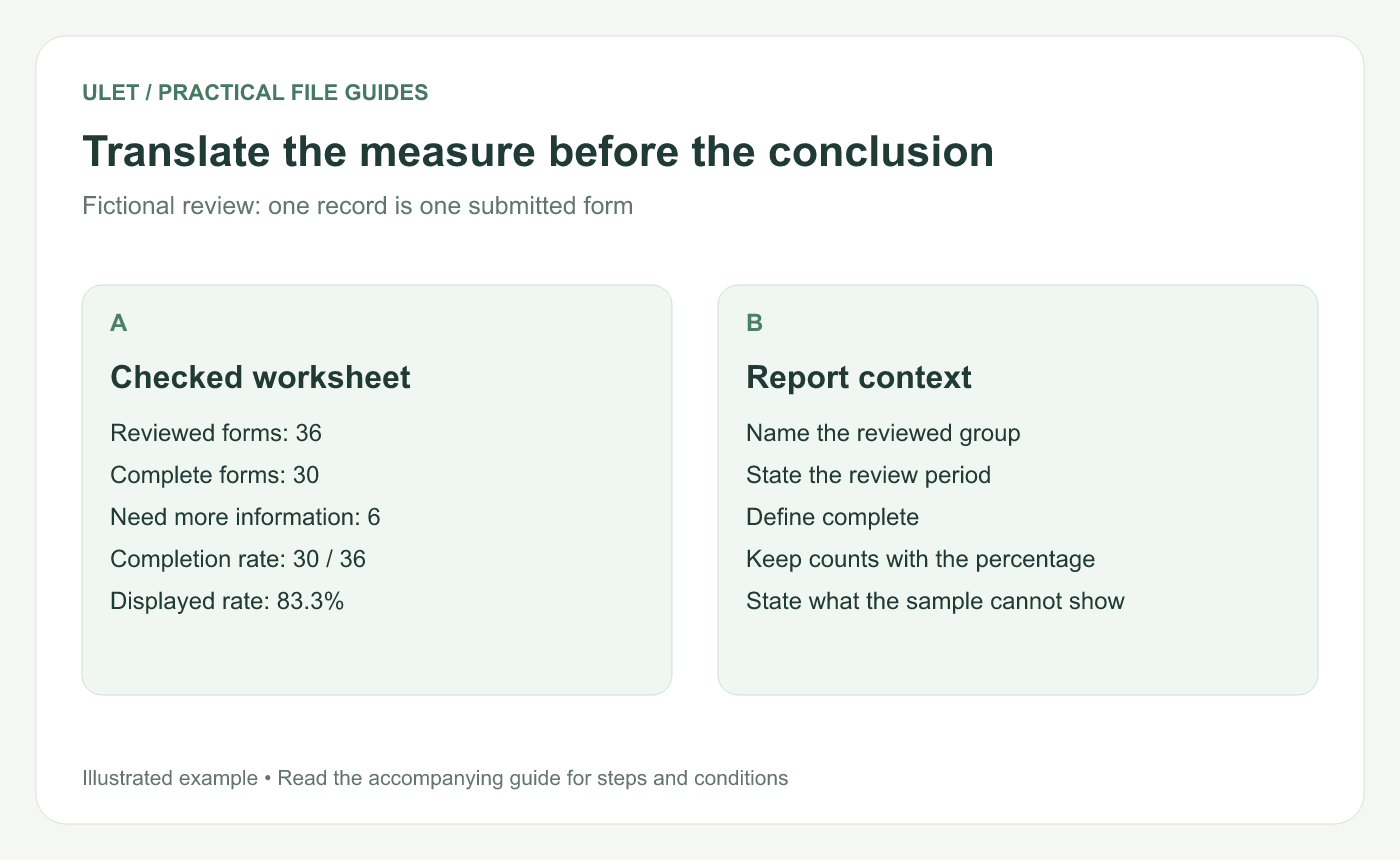
Translate the measure before the conclusion. Original instructional illustration; sample records are examples, not product screenshots or observed test results.
Check the worksheet before writing
For a fictional example, suppose a review contains 36 submitted forms. Thirty have every required field and six need more information. The completion rate is 30/36, displayed as 83.3% to one decimal place.
Confirm that one row represents one form and that repeated updates are not counted as new submissions. Record the review period and the actual rule used for complete.
Write a paragraph the evidence supports
In the reviewed set, 30 of 36 forms were complete (83.3%). Six required additional information. The review used the stated required-field rule.
This is illustrative wording. In a real report, add the actual period, source reference and definition. Do not present these fictional counts as observed results.
Keeping counts beside the percentage gives the reader the size of the reviewed set. State rounding once and use it consistently.
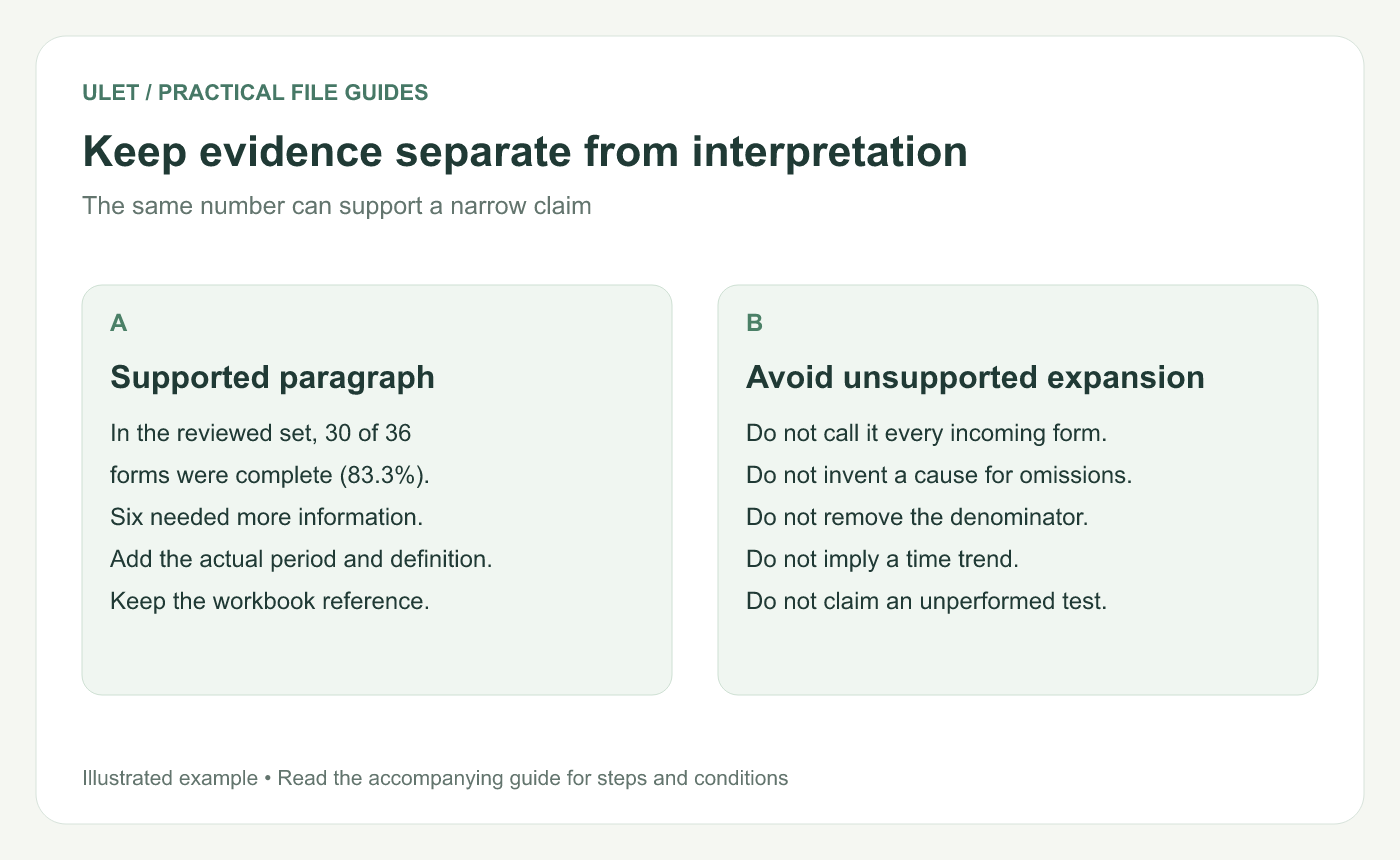
Keep evidence separate from interpretation. Original instructional illustration; sample records are examples, not product screenshots or observed test results.
Separate observation from explanation
The counts show that six forms in this set were incomplete under the rule. They do not establish why the information was missing.
If you propose reviewing those six cases, present that as a next action. If you identify a cause later, cite the additional evidence that supports it.
Keep the calculation traceable
Report element | Reference to retain |
|---|---|
Reviewed set | Source records and inclusion rule |
Complete count | The applied completeness definition |
Percentage | Numerator, denominator and rounding |
Interpretation | Supporting evidence or an explicit inference label |
A workbook cell reference helps locate the current result, but include the file version or reporting date too. A later edit can change the value in the same cell.
Read the paragraph against the records
Confirm the counts, period, units and qualifications. Check that the wording does not expand the reviewed set into an entire population or imply a trend from one snapshot.
Ulet lets you keep a local XLSX and written DOCX or Markdown report in one app on Windows and macOS. Update the report when the checked source changes, then inspect the issued copy before sharing it.


