
Build a local research reference folder around a small source index. Give each source a stable ID, record its origin and version, and keep the original files separate from your notes and finished outputs.
The index should let you answer a practical question later: which exact source supported this passage or calculation?
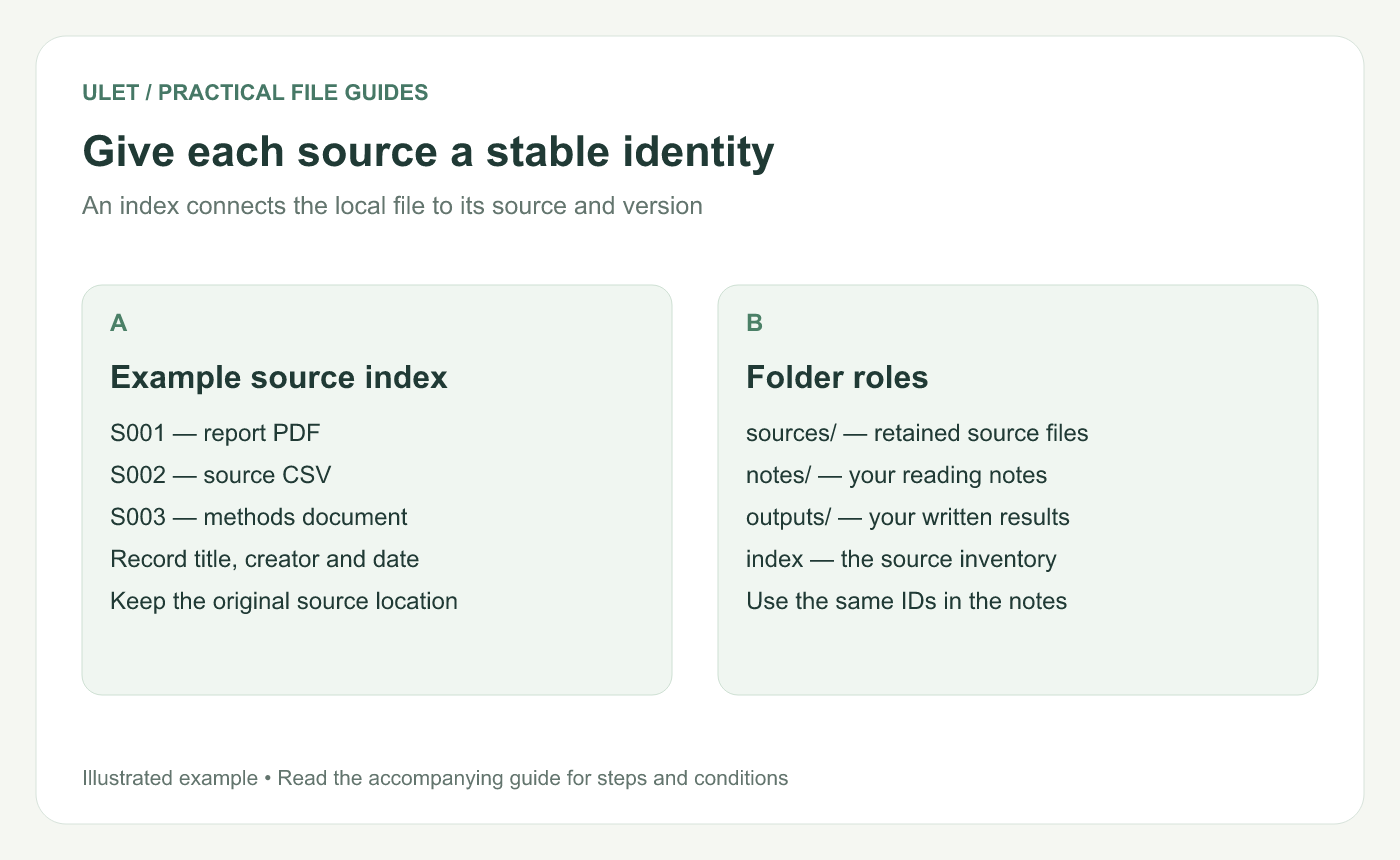
Give each source a stable identity. Original instructional illustration; sample wording and outcomes to check are not software screenshots or observed test results.
Use a few clear folder roles
Start with sources/, notes/ and outputs/. Keep an index at the project level so a new reader can find the source files without opening every note.
These names are examples. Choose a structure your project can maintain, then keep its roles consistent.
Record the identity before renaming the file
Index field | What it preserves |
|---|---|
Source ID | A stable reference such as S001 |
Title and creator | The identity of the material |
Date or version | The exact issue used |
Origin | A source URL, repository or supplied-file reference |
Local path | Where this copy is stored |
A download filename such as report-final.pdf is rarely enough on its own. Capture the source details while you still know where the file came from.
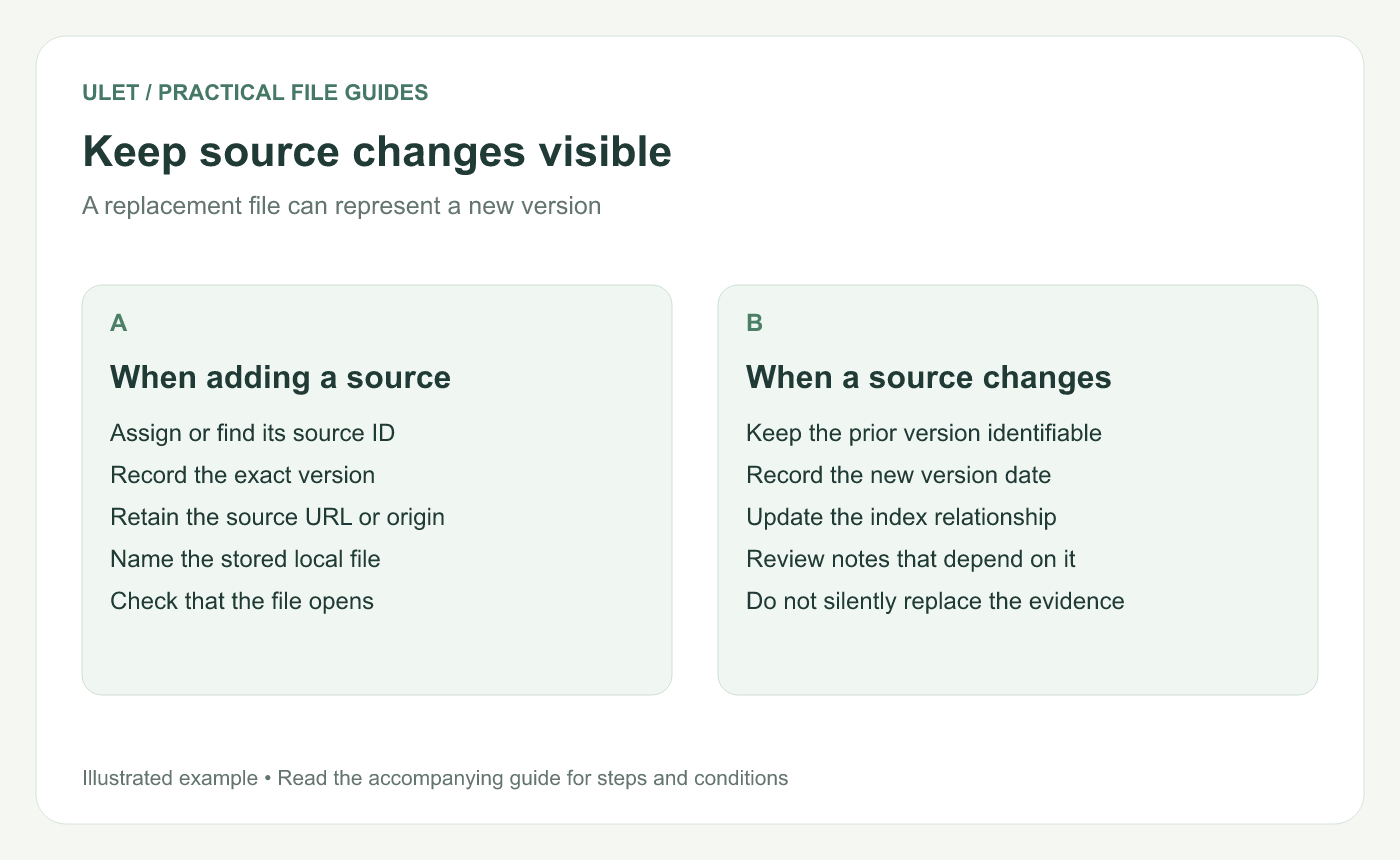
Keep source changes visible. Original instructional illustration; sample wording and outcomes to check are not software screenshots or observed test results.
Use the ID in the notes
In a reading note, record the source ID plus a page label, section heading or table reference. That gives the note a stable link to the inventory even if the local filename becomes more descriptive later.
Keep your interpretation in the notes rather than rewriting the retained source file. The structured PDF reading guide provides a separate format for those notes.
Handle new versions deliberately
When a report is revised, keep the old version identifiable if existing work depends on it. Add a version record and note which material it replaces.
Check notes and outputs that cite the earlier source. A new file with a familiar title does not automatically support the same statement or table reference.
Test the index from a real claim
Choose one statement in your draft output. Follow its source ID, open the indexed file and locate the supporting passage. Repair any missing step in that chain.
Ulet keeps local PDFs, spreadsheets, documents and Markdown notes in one app on Windows and macOS, with free basic editing. Use the source inventory to keep those files traceable as the research develops.


